The Best Knife Sharpeners of 2026: Work Sharp, Spyderco Sharpmaker, Lansky and More
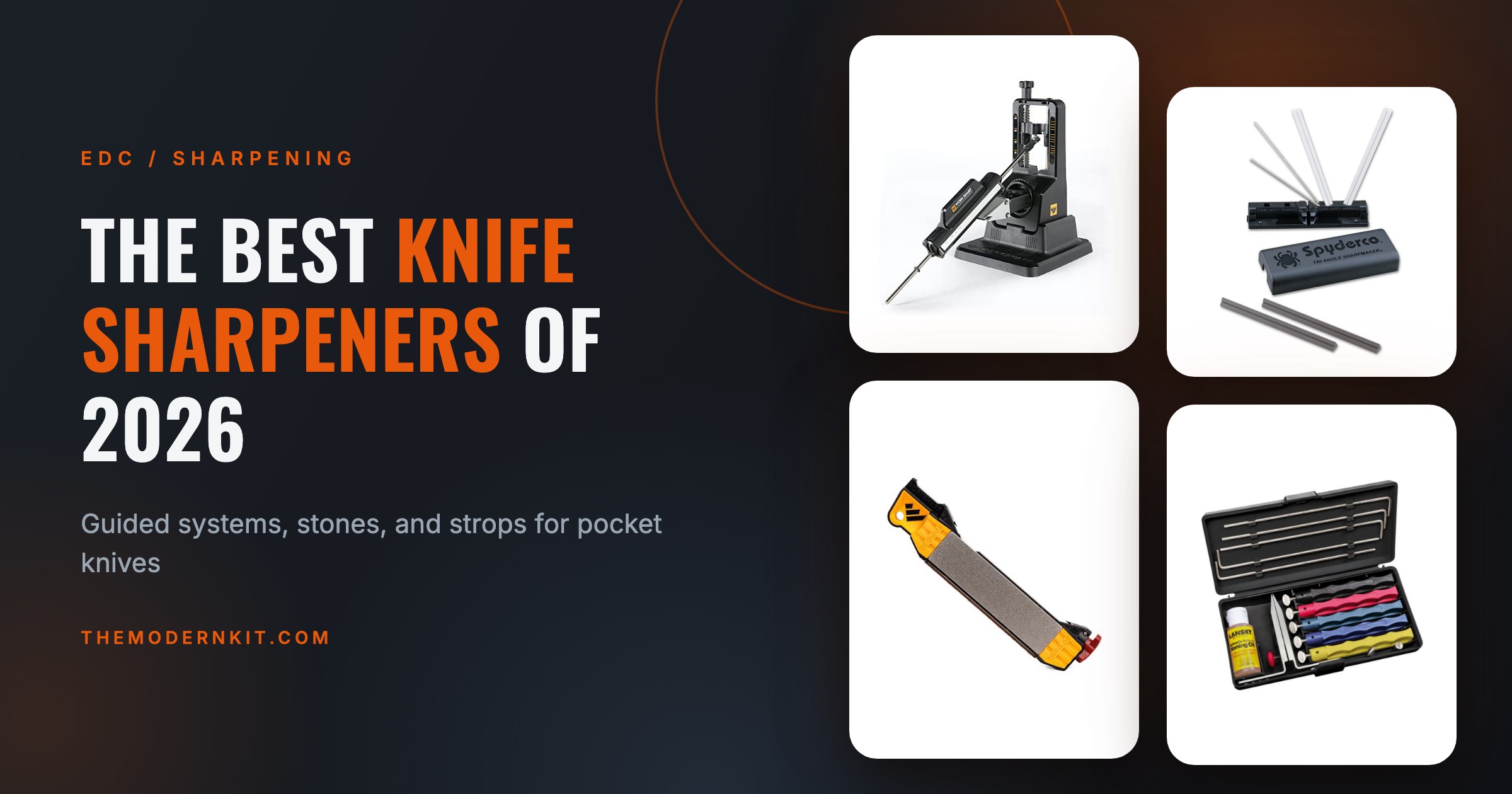
Quick answer: the best knife sharpener for most pocket knife owners is the Work Sharp Precision Adjust: a clamp-guided system that holds any angle from 15 to 30 degrees for about $70. For fast touch-ups and serrated blades, get the Spyderco Sharpmaker. For the pack or glovebox, the 4.6-ounce Work Sharp Guided Field Sharpener. If you want to learn freehand, a Sharp Pebble 1000/6000 whetstone costs about $45.
Our picks at a glance:
- Best Overall: Work Sharp Precision Adjust
- Best for Touch-Ups and Serrations: Spyderco Tri-Angle Sharpmaker
- Best Portable: Work Sharp Guided Field Sharpener
- Best Budget Guided Kit: Lansky Deluxe 5-Stone Sharpening System
- Best Whetstone: Sharp Pebble Premium Whetstone 1000/6000
- Best for Super Steels: DMT Dia-Sharp D8F/C Double-Sided Diamond Plate
- Best Strop: BeaverCraft LS2P1 Leather Strop with Compound
- Best Powered Sharpener: Work Sharp Ken Onion Edition Mk.2
A good sharpener does two things: holds a consistent angle, and removes steel at a sensible speed for the steel you carry. We weighed both, plus how much the tool can do beyond a single plain-edge folder (serrations, recurves, kitchen knives, axes), how much skill it asks of you, and whether owners and reviewers from outlets like Outdoor Life and GearJunkie report edges that hold up. Every pick is aimed at pocket knives first. Kitchen-only gadgets like rolling sharpeners and pull-throughs did not make it; carbide pull-throughs in particular remove too much steel and leave a rough edge. The list runs from a $15 strop to a $170 belt sharpener, and the right choice depends less on budget than on how you like to work: some people want a machine to hold the angle, others want a stone and ten quiet minutes. There is a good option here for both, and plenty of owners end up with two: a guided tool for real sharpening and something small for touch-ups.
New to this? Our step-by-step guide on how to sharpen a pocket knife covers angles, burrs, and stropping, and will help you decide whether you want guidance or a bare stone.
| Sharpener | Type | Angles (per side) | Abrasives | Serrations | Price |
|---|---|---|---|---|---|
| Work Sharp Precision Adjust | Clamp-guided | 15 to 30, 1 degree steps | 320 and 600 diamond, fine ceramic | No | $70 |
| Spyderco Sharpmaker | V-rod | 15 or 20 | Medium and fine ceramic | Yes | $127 |
| Work Sharp Guided Field | Pocket guided | 20 or 25 | 220 and 600 diamond, ceramic rods, strop | Yes | $40 |
| Lansky Deluxe 5-Stone | Clamp-guided | 17, 20, 25, 30 | 5 hones, 70 to 1000 grit | No | $55 |
| Sharp Pebble 1000/6000 | Whetstone | Freehand (15 guide) | 1000 and 6000 water stone | No | $45 |
| DMT Dia-Sharp D8F/C | Diamond plate | Freehand | 325 and 600 mesh diamond | No | $100 |
| BeaverCraft LS2P1 strop | Leather strop | Freehand | Leather, green compound | No | $15 |
| Work Sharp Ken Onion Mk.2 | Powered belt | 15 to 30 | 5 belts, P120 to 6000 | Yes | $170 |
1. Work Sharp Precision Adjust: Best Overall
The Precision Adjust is the easiest way to get a truly even, repeatable edge on a pocket knife without learning to freehand. A V-Block clamp holds the blade still while you sweep a three-sided abrasive (320 and 600 grit diamond plus a fine ceramic) across it, and the angle sets anywhere from 15 to 30 degrees in 1 degree steps, which covers every folder you are likely to own. It weighs 1.8 pounds on its benchtop base and carries a three-year warranty. It is for anyone who wants great edges on the first try; if you want more grits and a strop in the box, the Precision Adjust Elite (about $140) adds 220 to 800 grit diamond plates, a ceramic, and a leather strop. $70 at Amazon.
2. Spyderco Tri-Angle Sharpmaker: Best for Touch-Ups and Serrations
The Sharpmaker has been the knife-nerd default for decades because it makes maintenance almost thoughtless. Two pairs of triangular high-alumina ceramic stones (medium brown, fine white) key into an ABS base at 15 or 20 degrees per side; you hold the blade vertical and draw it down each rod. The flat faces do plain edges and the corners get into serrations, which most clamp systems cannot. Aluminum safety rods protect your hand, and the base doubles as the storage case. The ceramics are slow at reprofiling hard steels, so it is best for keeping a good edge good. $127 at Academy Sports + Outdoors.
3. Work Sharp Guided Field Sharpener: Best Portable
This is the sharpener to leave in the truck, the tackle box, or the pack. In 4.6 ounces, Work Sharp fits 220 and 600 grit diamond plates, a fine ceramic rod with a fish hook groove, a tapered ceramic for serrations, and a small leather strop, plus built-in guides that set 20 and 25 degree angles. It will not give you a mirror polish, but it restores a working edge in a couple of minutes anywhere. Three-year warranty. $40 at Amazon.
Shop the Guided Field Sharpener →
4. Lansky Deluxe 5-Stone System: Best Budget Guided Kit
The Lansky is the original clamp-and-rod kit and still the cheapest way to get guided precision. The clamp has slots for 17, 20, 25, and 30 degrees, and the kit includes five color-coded hones from 70 to 1000 grit, honing oil, and a hard storage case. It takes more fiddling than the Work Sharp (you screw the clamp onto the spine, and the angle drifts slightly on long blades), and the standard hones are slow on super steels. For a 14C28N or VG-10 folder, though, it produces excellent edges for about half the money. $55 at Best Buy.
5. Sharp Pebble 1000/6000 Whetstone: Best Whetstone
If you want to learn to sharpen properly, start here. The Sharp Pebble is a two-sided water stone, 1000 grit for sharpening and 6000 for polishing, that comes with a non-slip bamboo base and a clip-on angle guide set at 15 degrees. It uses water, not oil, and it handles the soft-to-mid steels in most pocket knives well. Freehand sharpening takes practice, but the skill works on every knife in the house, from your folder to your chef's knife. The King KW65 1000/6000, about $45, is the classic Japanese alternative. $46 at Lowe's.
Shop the Sharp Pebble whetstone →
6. DMT Dia-Sharp Diamond Plate: Best for Super Steels
Diamond cuts anything, and that matters if you carry M390, S90V, or MagnaCut, which glaze ordinary stones. DMT's Dia-Sharp is a continuous diamond surface on a flat steel plate, 8 by 3 inches, with 325 mesh coarse (45 micron) on one side and 600 mesh fine (25 micron) on the other. It needs no soaking or oil, just a little water, never dishes, and doubles as a flattening plate for your water stones. It is made in the USA. Follow it with a ceramic or strop, since 600 mesh leaves a toothy edge. About $100 from DMT.
7. BeaverCraft Leather Strop: Best Strop
A strop is the cheapest upgrade in sharpening. BeaverCraft's cowhide strop comes with a bar of green polishing compound; ten passes after sharpening strips the last of the burr, and a few passes a week keep a working edge crisp far longer. It is small enough for a desk drawer. It will not fix a dull knife, only refine a sharp one, so pair it with any sharpener on this list. About $15 from BeaverCraft.
8. Work Sharp Ken Onion Edition Mk.2: Best Powered Sharpener
Powered sharpeners are the fastest way through a drawer full of dull blades, and this is the best of the consumer belt grinders. The Mk.2 runs 3/4 by 12 inch belts through a seven-speed motor with an LED display, and its adjustable guide sets 15 to 30 degrees. Five belts, P120 through 6000, come in the box. Belts leave a slightly convex edge that many hunters and campers prefer. The learning curve is short but real: a belt removes steel fast, so go slow on the low speeds and keep your tip out of the belt. The simpler Work Sharp Knife and Tool Sharpener Mk.2 (about $90, fixed 20 and 25 degree guides) costs a lot less. $170 at Lowe's.
How to choose a knife sharpener
- Guided or freehand. Guided systems (Precision Adjust, Lansky, Sharpmaker) remove the hardest part, holding the angle. Stones and plates are cheaper and faster once you have the skill.
- Match the abrasive to the steel. Ceramic and aluminum oxide handle 8Cr13MoV, 14C28N, VG-10, and 154CM well. For M390, S90V, and other high-vanadium steels, use diamond. Our knife steel guide explains which is which.
- Know your angle. Most folders ship around 15 to 20 degrees per side. A sharpener that can match it saves you from reprofiling the whole bevel.
- Serrations need rods. If you carry a serrated or combo edge, pick a sharpener with a tapered or triangular ceramic.
- Add a strop. Whatever you buy, a strop makes the edge last longer between sessions.
Guided system, whetstone, or powered: which do you need?
Buy a guided system if you want results now. A clamp kit like the Precision Adjust or Lansky locks the angle, so your first edge will look like your hundredth. The trade-off is setup time: you clamp the knife, pick the angle, and work each side in turn. That is fine for a sharpening session on the weekend and overkill for a quick touch-up before work.
Buy rods or a pocket sharpener for maintenance. The Sharpmaker and Guided Field Sharpener come out of the drawer and go back in within two minutes. Neither is the fastest way to fix a chipped edge, but both keep a sharp knife sharp, which is most of what a daily carry blade needs.
Buy a stone or diamond plate if you want the skill. Freehand sharpening takes a few weekends of practice. After that, one stone handles pocket knives, kitchen knives, and garden tools, and you can sharpen anywhere without a clamp that might not fit an odd blade shape. Diamond plates are the choice for super steels and double as a flattener for water stones.
Buy a powered sharpener for volume. If you maintain a household of kitchen knives, hunting blades, a hatchet, and a mower blade, a belt sharpener pays for itself in time. For a single folder, it is more tool than you need.
Whatever you choose, the fundamentals are the same: consistent angle, a burr raised along the full edge on both sides, a finer grit to refine it, and a strop to finish.
The Bottom Line
For most people, the Work Sharp Precision Adjust is the sharpener that turns out a better edge than the factory one on the first try. Keep a Spyderco Sharpmaker on the desk for weekly touch-ups, or a Guided Field Sharpener in the bag. If you carry a super steel, add the DMT plate. And if you want the knife to go with it, see our best EDC pocket knives of 2026.
Keep reading: How to Sharpen a Pocket Knife | Pocket Knife Steel Explained | The Best EDC Pocket Knives of 2026 | The Best Multitools of 2026
Frequently Asked Questions
What is the best knife sharpener for pocket knives?
For most people, a clamp-guided system like the Work Sharp Precision Adjust is best because it holds a precise angle from 15 to 30 degrees and needs almost no skill. The Spyderco Sharpmaker is the best for quick touch-ups and serrated edges, and a 1000/6000 whetstone is best if you want to learn freehand.
Is the Spyderco Sharpmaker worth it?
Yes, if you want fast, consistent maintenance. Its ceramic rods lock in 15 or 20 degrees per side, handle both plain and serrated edges, and the kit stores in its own base. It is slow at reshaping a very dull or chipped edge in hard steel, so pair it with a diamond plate for repairs.
Do I need a diamond sharpener for S30V or M390?
Not strictly for S30V, which sharpens on good ceramic or water stones, but diamond is much faster. For M390, S90V, and other high-vanadium steels, diamond is strongly recommended because their hard vanadium carbides glaze and resist ordinary stones. A plate like the DMT Dia-Sharp handles any steel.
Are electric knife sharpeners good for pocket knives?
Belt-driven sharpeners like the Work Sharp Ken Onion Mk.2 work well on pocket knives and leave a durable convex edge, but they remove steel quickly, so use low speeds and light pressure. Avoid grinding-wheel kitchen sharpeners on good folders; they overheat thin edges and take off too much metal.
What is the difference between Work Sharp Precision Adjust and Precision Adjust Elite?
Both use the same clamp and 15 to 30 degree adjustment in 1 degree steps. The standard model includes a three-sided abrasive with 320 and 600 grit diamond plus fine ceramic for about $70. The Elite, about $140, adds diamond plates from 220 to 800 grit, a ceramic, and a leather strop.
This post contains affiliate links. If you buy through them, we may earn a small commission at no extra cost to you.