The Best Trail Running Gear of 2026: Shoes, Vests, Headlamps & More
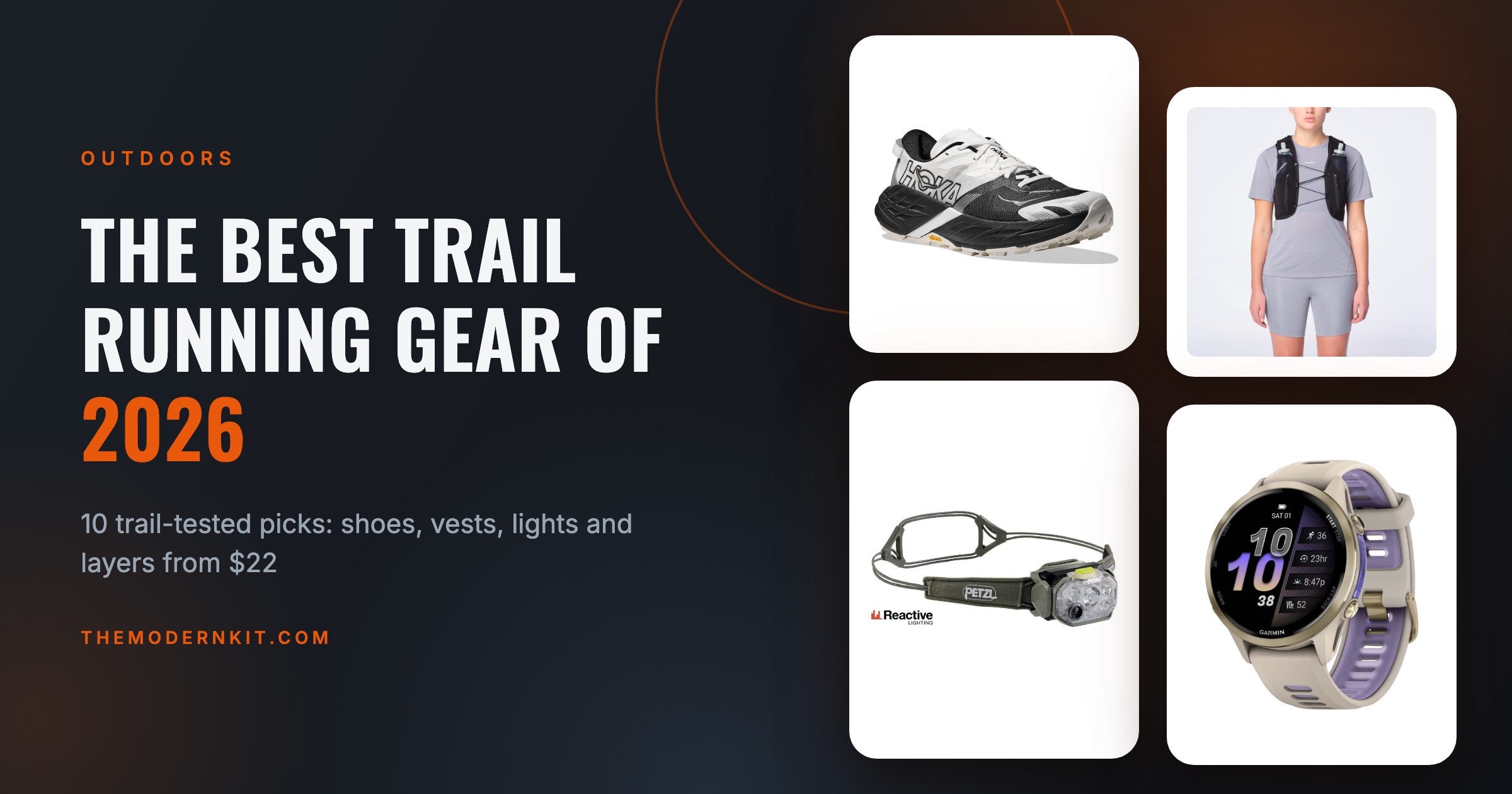
Quick answer: the best trail running gear of 2026 starts with the right shoe: the HOKA Speedgoat 7 for most runners, the Salomon Speedcross 6 if your trails are muddy, or the ASICS Gel-Venture 10 at about $80 if you are just starting out. Add a Salomon ADV Skin 12 vest for water on anything over an hour, a Petzl Swift RL headlamp for fall's short days, and a Patagonia Houdini wind shell, and you are ready for almost any trail.
Our picks at a glance:
- Best Overall Trail Shoe: HOKA Speedgoat 7
- Best for Mud and Soft Ground: Salomon Speedcross 6
- Best Budget Trail Shoe: ASICS Gel-Venture 10
- Best Hydration Vest: Salomon ADV Skin 12
- Best Headlamp: Petzl Swift RL
- Best Trail Running Poles: Black Diamond Distance Carbon Z
- Best Wind Shell: Patagonia Houdini
- Best GPS Watch: Garmin Forerunner 970
- Best Trail Running Socks: Darn Tough Run Micro Crew Ultralight
- Best Trail Running Shorts: Patagonia Strider Pro 5"
Trail running is the best thing that ever happened to a runner who is bored of pavement: softer ground, better views, and a workout that hits muscles road miles miss. It also asks more of your gear. Roots, rocks, mud, and miles between water fountains mean the shoes, pack, and layers that work on a city loop can let you down out there. We picked ten items that cover the whole kit, from your first muddy park trail to a mountain race, leaning on long-term testing from trail-specific reviewers and our own miles.
Prices below are the retailer prices we saw at publication. Shoes and Patagonia layers in particular go on sale often, so check before you buy.
| Pick | Type | Standout | Price |
|---|---|---|---|
| HOKA Speedgoat 7 | Trail shoe | Cushion plus grip, does everything | $165 |
| Salomon Speedcross 6 | Trail shoe | Deep lugs for mud and wet grass | $155 |
| ASICS Gel-Venture 10 | Trail shoe | Real trail grip under $100 | $80 |
| Salomon ADV Skin 12 | Hydration vest | 12L, two 500ml flasks included | $165 |
| Petzl Swift RL | Headlamp | 1,100 lumens, auto-dimming beam | $135 |
| Black Diamond Distance Carbon Z | Folding poles | About 10 oz a pair, folds to stash | $220 |
| Patagonia Houdini | Wind shell | Under 4 oz, packs into a pocket | $119 |
| Garmin Forerunner 970 | GPS watch | Multi-band GPS, topo maps, flashlight | $750 |
| Darn Tough Run Micro Crew Ultralight | Merino socks | Blister-free, lifetime guarantee | $22 |
| Patagonia Strider Pro 5" | Shorts | Liner and waistband pockets | $89 |
1. HOKA Speedgoat 7: Best Overall Trail Shoe
The Speedgoat is the trail shoe testers keep coming back to, and the seventh version is the most balanced yet: deep, plush cushioning for long days, a Vibram Megagrip outsole with 5mm lugs that bites on wet rock and loose dirt, and a wide, stable base that keeps your ankles honest on off-camber singletrack. It is light enough to feel quick, protective enough for an ultra, and comfortable from the first run. If you only buy one pair of trail shoes, buy these. $165 at Zappos.
2. Salomon Speedcross 6: Best for Mud and Soft Ground
Nothing grips soft ground like a Speedcross. The aggressive chevron lugs claw into mud, wet grass, and steep loose climbs where flatter outsoles skate, and Salomon's Quicklace cinches tight with one pull so you never stop to retie. The trade-off is that those big lugs feel squirmy on pavement and hard-packed fire roads, so think of it as your bad-weather shoe for fall and winter, not your only shoe. $155 at Zappos.
3. ASICS Gel-Venture 10: Best Budget Trail Shoe
Not sure trail running is your thing yet? Start here. The Gel-Venture 10 gives you a real lugged outsole, a rock-resistant toe, and ASICS' rear-foot GEL cushioning for around half the price of the shoes above. It is heavier and less nimble than a dedicated race shoe, and it will not love technical scrambles, but for groomed park trails, gravel paths, and weekend hikes it is the best value going. $80 at Academy Sports.
4. Salomon ADV Skin 12: Best Hydration Vest
The reference vest that every other running pack gets measured against. It fits like a stretchy shirt rather than a backpack, so it does not bounce even when it is full, and 12 liters is the sweet spot: enough for a rain shell, a headlamp, food, and the mandatory kit most ultras require, but small enough to wear on a two-hour run. Two 500ml soft flasks ride up front where you can grab them without stopping. Sizes run snug, so check the chart. $165 at Salomon.
5. Petzl Swift RL: Best Headlamp
Fall means shorter days, and a good headlamp is what keeps your after-work run on the trail instead of the treadmill. The Swift RL puts out up to 1,100 lumens, and Petzl's Reactive Lighting sensor dims and brightens the beam automatically as you look down at your feet or up the trail, which stretches the battery a long way. It recharges over USB-C and sits comfortably without bouncing. Wondering how much light you actually need? See our lumens explainer. $135 at REI.
6. Black Diamond Distance Carbon Z: Best Trail Running Poles
Poles are the upgrade that surprises people most. On steep mountain climbs they turn your arms into a second set of legs, and on long descents they take real load off your quads and knees. The Distance Carbon Z folds into three sections in seconds and weighs about 10 ounces a pair, so it stashes in a vest when the trail flattens out. These are fixed-length, so measure before you order (forearm parallel to the ground with your elbow at 90 degrees). $220 at Backcountry.
7. Patagonia Houdini: Best Wind Shell
The Houdini is the layer you carry on every run and forget is there. It weighs under 4 ounces, stuffs into its own chest pocket about the size of an apple, and blocks the wind that turns a sweaty ridgeline into a shivering one. A DWR finish shrugs off light drizzle, but it is not a rain jacket; in real weather you want a waterproof shell. For 90 percent of fall runs, though, this is all the jacket you need. $119 at Backcountry.
8. Garmin Forerunner 970: Best GPS Watch
Garmin's top running watch is built for the trail: multi-band GPS that stays accurate under tree cover and in canyons, full on-watch topo maps with turn-by-turn navigation, a bright AMOLED screen, and a built-in LED flashlight that is genuinely handy at a dark trailhead. Training readiness and recovery tracking tell you when to push and when to back off. It is a big spend; if you mostly run roads and only dip onto trails, a cheaper Forerunner will do. $750 at Backcountry.
9. Darn Tough Run Micro Crew Ultralight: Best Trail Running Socks
Blisters end more trail runs than sprained ankles. Darn Tough's merino running sock is thin enough to keep your shoe fit precise, wicks sweat and stays warm when wet, and the micro crew height keeps grit and pine needles out of your shoes. They are backed by a lifetime guarantee, which you will probably never need. Here is why merino beats cotton for anything you sweat in. $22 at REI.
10. Patagonia Strider Pro 5": Best Trail Running Shorts
The Strider Pro is a trail runner's short through and through: a quick-drying shell, a soft built-in liner, and a wide waistband ringed with stretch pockets that hold a phone and a handful of gels without flopping around. That means you can leave the vest at home on shorter runs. Prefer more coverage? The 7-inch version has the same feature set. $89 at Backcountry.
The Bottom Line
Spend on shoes first: the HOKA Speedgoat 7 handles almost any trail, and the ASICS Gel-Venture 10 is a smart, cheap way to find out if you love it. Once your runs pass an hour, a Salomon ADV Skin 12 and a Petzl Swift RL are the next two buys, and the Darn Tough socks are the cheapest upgrade on this list that you will feel on every run. Heading out for a full weekend instead? Our car camping gear guide covers the basecamp.
Keep reading: Best car camping gear | Best bike commuting gear | Best EDC flashlights | Merino wool vs cotton
Frequently Asked Questions
What gear do you need for trail running?
At minimum you need trail running shoes with lugged outsoles and socks that do not cause blisters. For runs over an hour, add a hydration vest or handheld bottle, and carry a light wind shell. A headlamp is essential if you might finish after dark, and poles help on steep mountain trails.
Can you use road running shoes on trails?
On smooth, dry dirt paths and gravel, road shoes work fine. On roots, rocks, mud, or steep terrain, trail shoes are safer: their deeper lugs grip loose and wet ground, and tougher uppers and rock plates protect your feet from sharp rocks.
Do you need a hydration vest for trail running?
For runs under an hour in mild weather, most people do not. Beyond an hour, or anywhere without water along the route, a hydration vest is the most comfortable way to carry water, food, a layer, and a phone, because it holds everything close to your body without bouncing.
How many lumens do you need for trail running?
Around 300 to 500 lumens is enough for most trail running at a steady pace. Technical terrain and fast descents benefit from 600 lumens or more. Headlamps with reactive or adaptive lighting, like the Petzl Swift RL, adjust brightness automatically to save battery.
Are trekking poles worth it for trail running?
On steep, mountainous trails, yes. Poles let your arms help on climbs and reduce load on your knees and quads on descents. On flat or rolling trails they mostly get in the way, so folding poles that stash in a vest are the most versatile choice.
This post contains affiliate links. If you buy through them, we may earn a small commission at no extra cost to you.